Practice
Why rereading notes feels like learning
Reading a page again feels smooth, and that smoothness is easy to mistake for knowledge. Recalling it cold is harder, and it works far better.
by Daniel Okoye · 5 min read
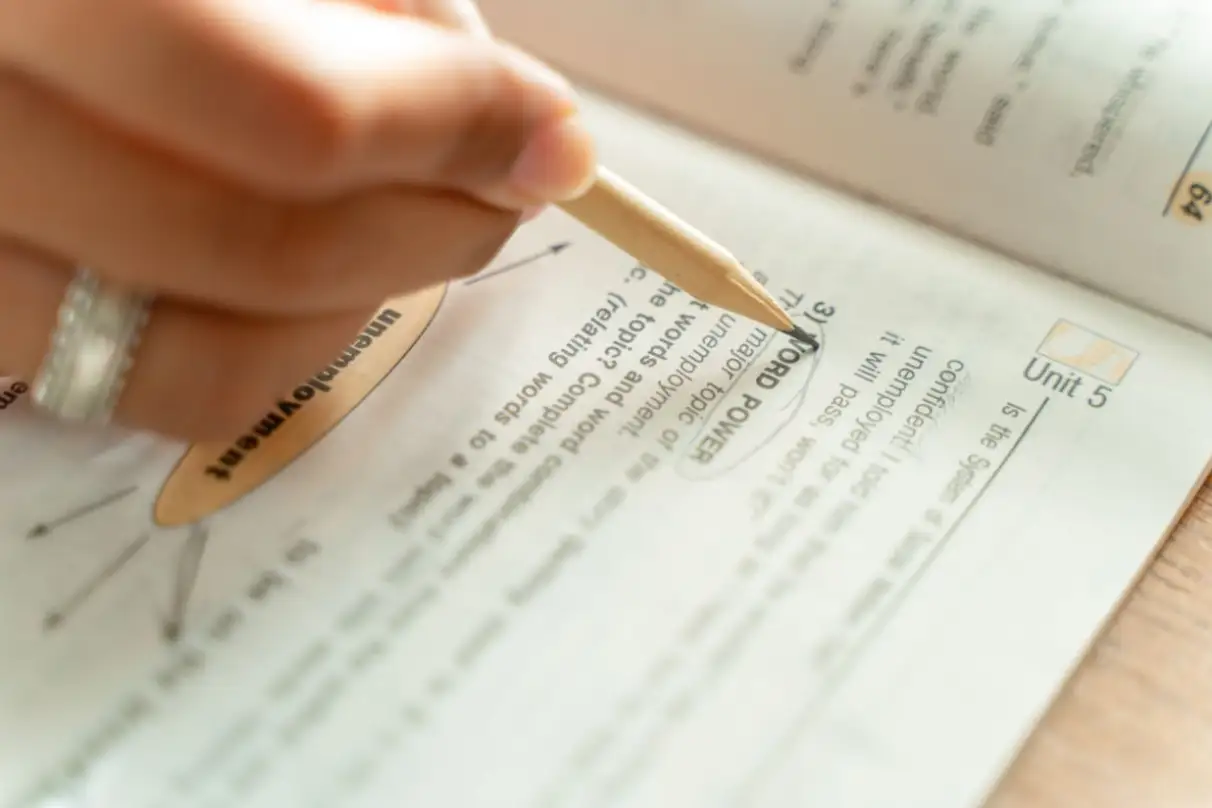
A page of notes your child has read four times feels safe. The words are familiar. The shape of the paragraph is recognisable. They close the book and say, ‘I know this.’ A week later, in a test, the same page might as well be blank. That gap is not laziness. It shows that rereading does a different job from the one we think it does.
This page explains why the warm feeling of a familiar page can mislead, what happens in memory when it does, and what to do instead. It is for parents of school pupils in the UK, from the first years of primary school through to A-level. The methods are plain. None require a printer or a subscription, and none need a quiet hour carved out of a busy evening.
We are Cornerstone Learning Tutors. We teach maths, English and science. We also run 11+ entrance preparation and exam preparation for GCSE and A-level. Lessons are one-to-one. They run online or at home for pupils aged 7-18. Our tutors are DBS-checked and qualified, and we send progress reports to parents. There is no sales pitch here. The page explains a problem we see in almost every first lesson.
The advice below focuses on how to work so that it leaves a mark. Longer sessions are not the answer. A pupil can spend forty minutes rereading and still struggle to produce the same page the next day. Ten minutes of retrieval can show more.
The warm feeling of a familiar page
Rereading has a place. It is how most of us first meet a topic. The trouble starts when rereading becomes the main way a pupil studies. The page feels easier on the second pass. The sentences run more smoothly. The pupil turns the page with a sense of progress. That sense is real, but it is familiarity, not knowledge.
Cognitive scientists call this the illusion of fluency. The brain uses ease as a clue. If something is easy to process, it feels known. If it feels known, it feels learned. The clue is unreliable. A song lyric can feel familiar after two listens without you being able to sing the next line on your own. A recipe can look obvious while you read it and feel impossible when the pan is hot.
Your child is not lying when they say they know it. They are reporting a feeling. The feeling is genuine. The problem is that it is not the same as the ability to produce the information when the book is closed.
Recognition is not recall
These are two different mental acts, and they are easy to confuse. Recognition is the sense that something is familiar when you see it. Recall is pulling it out of memory without the prompt in front of you. Rereading mostly trains recognition. Tests mostly ask for recall.
The plain analogy is a sat nav. If you follow the sat nav from your house to a new sports centre, the route feels known. You recognise the turnings as they arrive. Then the sat nav dies, or a road is closed, and you have to find your own way. The route that felt familiar is suddenly not there. You did not learn the route. You learned to follow instructions. Rereading is following the sat nav. Retrieval is driving the route yourself, with the map face down.
That is why a pupil can highlight a whole page and still freeze in an exam. The exam does not show them the page. It gives them a question and asks them to produce the route.
The highlighter trap and the pretty page
Highlighting a page feels like studying. So does copying notes into a fresh notebook. They keep the hand busy and the page tidy. They also let the eye move over the words without asking the brain to produce anything. The result can be a beautiful set of notes and a thin memory of what is in them.
The same is true of reading aloud. It can help with pronunciation, and it can help a younger pupil slow down. It does not prove that the meaning has stuck. A pupil can read a paragraph fluently and still be unable to tell you what the paragraph was about.
Pens and colour still have a use. Put a harder step after the colouring. Close the book. Write down three things you remember. Then check. The gap between what they remembered and what is on the page is the useful part. It shows exactly where the memory is thin and what needs another pass.
What the exam paper actually asks for
An exam paper is a blank page with questions on it. For most subjects, the pupil has to generate the answer, the method, the quotation or the equation. In an 11+ paper, that might be a word problem or a short comprehension answer. In a GCSE science paper, it might be a required practical or a calculation. In an A-level essay, it might be a line of argument built from evidence. None of those tasks are solved by recognising a page.
Some papers include multiple-choice questions, and those do reward recognition to a degree. But recognition alone is not enough. A pupil still has to choose between close options, and close options are designed to catch a half-remembered idea. The safer preparation is to practise producing the answer before seeing the options.
Why this shows up at every age
The same pattern appears from primary school to sixth form, from a seven-year-old reading a phonics page to an eighteen-year-old reading a model essay. A nine-year-old reads a topic page about the Romans and can point to the right paragraph. A thirteen-year-old reads a science page about cells and feels confident. A sixteen-year-old reads a poem annotation and thinks the analysis is obvious. An eighteen-year-old reads a model essay and thinks the argument is clear.
In each case, the page is doing some of the work. The pupil is recognising the content in front of them. The test removes the page. The gap points to the practice, not to the pupil’s ability.
This is one reason we teach pupils aged 7 to 18. The subject matter changes, but the study habit does not. A pupil who learns to close the book and retrieve at nine is better placed at fourteen. A pupil who only rereads at fourteen can still change the habit, but the change needs to be deliberate.
A short retrieval routine that fits a school night
Retrieval practice is the plain name for pulling information out of memory. It does not need to be a big production. Ten minutes is enough to start. The routine below works for a single page of notes or a single topic.
Start with a blank page
Ask your child to close the book and write down everything they can remember about the topic. It can be a list, a diagram, a set of equations or a short paragraph. The form does not matter. The act of production does. If they cannot start, ask them to write the topic title and one thing they know. That is enough to break the blank page.
Check, then mark the gaps
Open the book and compare. Use a different pen to add what was missing. Do not rub anything out. The missing pieces are the useful information. They show exactly where the memory is thin. A pupil who can see their own gaps is in a better position than a pupil who has only seen a clean page.
Space it out
A single retrieval session is a start, not a finish. The same topic should come back after a day, then after a few days, then after a week or two. The gap should be long enough to make the recall a little uncomfortable. If it is too easy, the gap can grow. If it is too hard, shrink it. This is not a precise science, and a tutor can help you judge it.
Mix the topics
Once the basics are in place, mix questions from two or three topics in one session. A pupil who only practises one topic at a time can get used to the pattern of that topic. A mixed set asks them to choose the right method as well as use it. That is closer to what an exam does.
How to help at home without taking over
The most useful thing a parent can do is ask a question that cannot be answered by pointing at a page. ‘Can you tell me what that page was about without looking?’ is a good start. ‘Can you teach me the difference between these two things?’ is another. ‘What would you put on a postcard about this topic?’ works well for younger pupils.
Keep it short. A few questions on the walk home from school are often more useful than an hour at a desk. A short set of questions on the walk back from the bus stop on Otley Road can be enough. The pupil does not see it as a test, and the parent gets a quick sense of what has stuck.
Do not turn every conversation into an interrogation. If the answer is ‘I don’t know’, treat it as information. Say, ‘Let’s look at that together later.’ Then do it. The aim is to make retrieval a normal part of the week.
When rereading still has a place
Rereading still does a job. It gets the first version of the information into the room. You cannot retrieve what you have never met. A pupil who is completely new to a topic needs to read and ask questions before retrieval makes sense.
Rereading also helps with checking a formula or reminding yourself of a quotation. It can settle nerves before an exam. The problem is when it is the only tool in the box. Use it as the first pass, then switch to retrieval. Read the page once, close it, write what you remember, then read it again to fill the gaps. That order uses both.
What a tutor does differently
In a one-to-one lesson, the tutor can see the difference between recognition and recall in real time. A pupil might nod along while a method is explained, then stall when asked to do the next step alone. That stall is useful. It tells the tutor where to slow down, what to re-teach and what to practise again.
Our lessons are built around that kind of checking. A tutor might start with a few questions from the previous lesson, then explain a new idea, then ask the pupil to produce it without prompts. The balance changes with the pupil. A younger pupil might need more scaffolding and shorter bursts. An A-level pupil might need longer written answers and more precise feedback.
We teach these subjects from 11+ through to A-level, in lessons online or at home. All of our tutors are DBS-checked and qualified. We send progress reports to parents, so you are not guessing what has happened in the lesson. We also keep one family coordinator across siblings and key stages, which matters if you have one child in year 3 and another in year 10. The reports and the coordinator join the dots between subjects and years.
The discomfort is part of the point
Retrieval feels harder than rereading. That is not a design fault. The effort of pulling something out of memory is part of what makes it stick. A pupil who only practises what feels easy is practising the feeling of ease, not the act of remembering.
This can be a difficult message for a pupil who has come to rely on rereading. They may say, ‘But this way takes longer.’ It does, at first. The page that felt smooth now feels bumpy. That bumpiness is feedback. It shows where the work is needed. Over time, the pupil learns to trust the bumpy feeling as a sign that something is happening.
Confidence tends to follow evidence. A pupil who has answered a question without the book, checked it, and corrected it has a small piece of evidence. A pupil who has read the page again has a feeling. The evidence is more useful on the day of the exam.
What to do this week
Pick one subject and one page of notes. Ask your child to read it once, close it, and write what they remember on a blank sheet. Then check it together and mark the gaps. Put the sheet away. Come back to the same topic in two days and try again. That is the whole routine. It takes less time than a colour-coding session.
If your child is preparing for 11+ or for GCSE and A-level exams, the same routine applies with harder material. The questions get longer, the mark schemes get tighter, and the gaps are more specific. A tutor can help by choosing the right questions and by showing the pupil how to check their own answers.
If you would like to talk about your child, call +44 113 9463420 or email [email protected]. We will ask what you have noticed and what the school has said. Then we will ask what you would like to change. After that, we can tell you whether one-to-one lessons are a sensible next step. Opening hours are confirmed when you book.
Read next
Basics · 6 min read
What a tutor does in the first hour
Practice · 5 min read
Why rereading notes feels like learning
Exams · 7 min read
Command words in GCSE papers, decoded
Study habits · 6 min read
A revision timetable that survives real life
Basics · 5 min read
How to read a school report properly
Practice · 5 min read
Retrieval practice for a nine-year-old
Exams · 6 min read
What 11+ examiners look for
Study habits · 4 min read
Helping with homework without taking over